
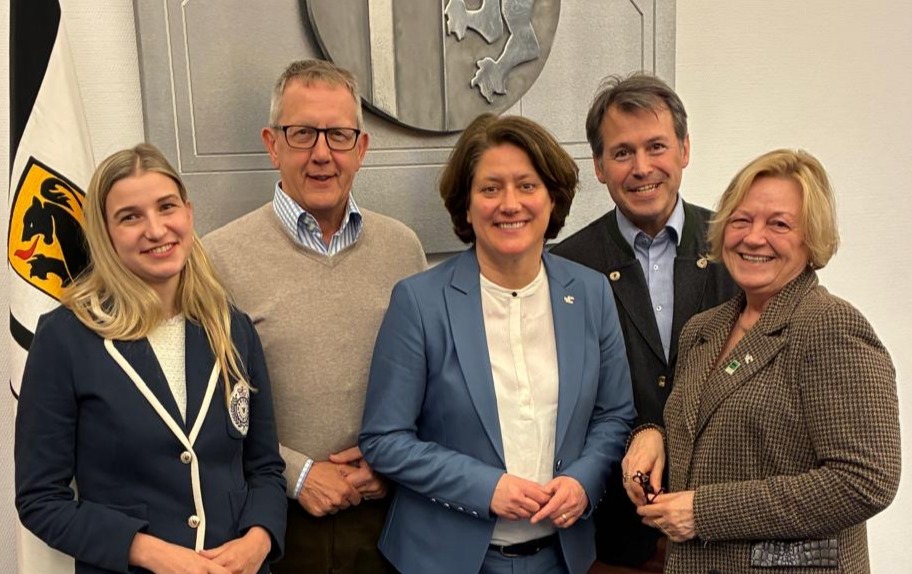
On 25 March 2026, the district council adopted the 2026 district budget. What does this mean for Meerbusch and how does it affect us?
The intensively discussed assessment rate for the district levy was set at 35.87 % - exactly the level that our mayor Christia Bommers and his counterparts in the Rhein-Kreis-Neuss district requested in their letter dated 24 February 2026. A global reduction in expenditure of 0.5 % was taken into account.
The decision shows: The district - just like the town of Meerbusch - is also facing considerable financial challenges. Rising social expenditure in particular, for example for transfer payments in accordance with SGB XII (assistance with living expenses), SGB IX (integration assistance) and SGB II (accommodation costs), as well as the higher regional levy are placing a noticeable burden on the budget.
The aim of the district budget is to safeguard the district's ability to act while at the same time not placing an excessive burden on the towns.
The district budget was ultimately approved by a large majority - supported by the CDU, FDP, SPD, Greens and UWG/Free Voters, among others.
A look at the development of the assessment rate shows that in 2025 it was still at 34.90 %. The current adjustment includes a slight increase in the assessment rate.
That's a lot of money for Meerbusch!
At the same time, it should not be forgotten that collection rates of around 40 % (peak: 45.71% in 2006) were adopted in the years prior to 2017.
In his budget speech, Wolfgang Wappenschmidt, parliamentary group leader of the district CDU, emphasised:
„This is the path we have taken: We combine consolidation with a focus on the future. We make savings where it makes sense. We are easing the burden on local authorities wherever possible. Without jeopardising the district's ability to act. After all, a district with the capacity to act is not an end in itself, but rather the prerequisite for tasks being reliably fulfilled, for local authorities receiving the support they need and for all of us - district, towns and municipalities - being able to actively shape the future. If this ability to act is weakened, the consequences are not limited to the district level. They have a direct impact on every single municipality.”
Werner Damblon, Chairman of the Meerbusch CDU parliamentary group, expressed his satisfaction with the decision: „I am pleased that an agreement has been reached in the district that also takes the interests of the municipalities appropriately into account.“